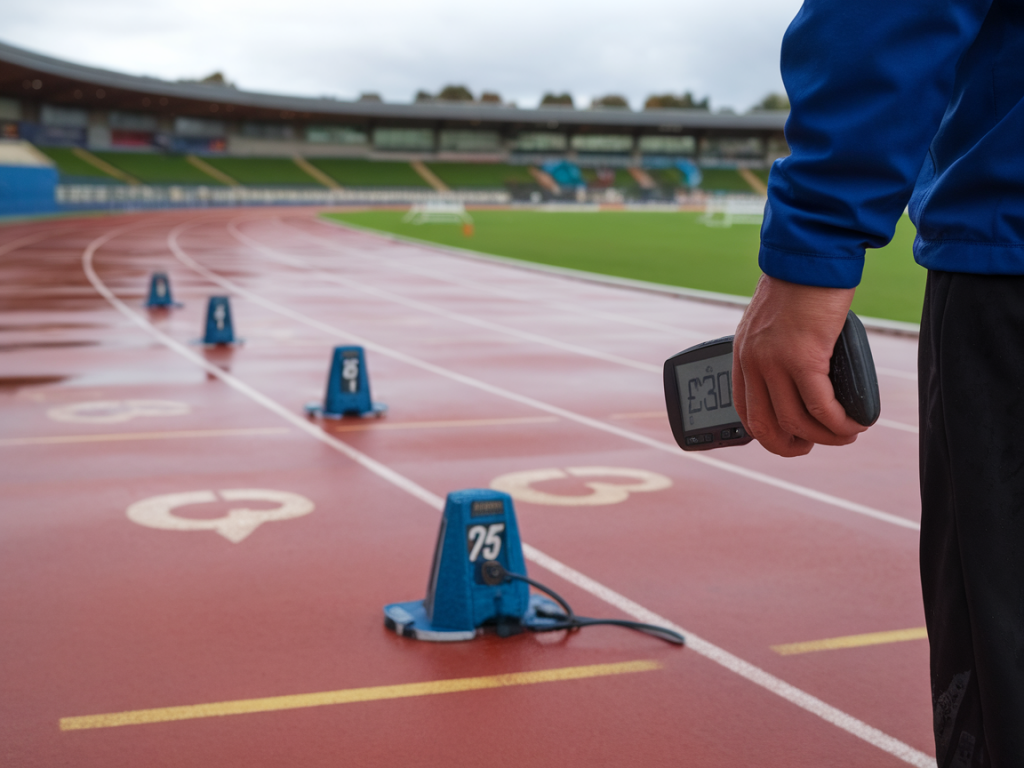
I’ve spent more time than I care to admit testing tech on the training pitch — from clip-on accelerometers to full Catapult setups — trying to answer the same practical question most semi-pro coaches ask: can a £300 GPS unit give the same sprint insights as Catapult? Short version: it depends what you mean by “the same”. Long version: read on — I’ll cover metrics that matter, where cheaper units can do the job, and where they fall short for coaches who need reliable sprint data to inform training.
What Catapult gives you (and why coaches value it)
When people say “Catapult” they mean a whole package: high-sampling GPS/GNSS plus a well-calibrated inertial measurement unit (IMU), validated algorithms (for sprint detection, accelerations, decelerations, load), cloud platform with analytics and reports, customer support, and the ecosystem of professional clubs that use the same device. Practically, that translates to:
That package is why sports scientists and professional coaches trust Catapult for nuanced sprint metrics: peak speed, 10–40 m splits, sprint count with minimal false positives, and detailed acceleration profiles.
What a £300 GPS unit can realistically provide
For roughly £300 you’re typically looking at consumer/entry-level GPS devices: small GPS loggers, GPS watches (Garmin, Polar), or low-cost youth/grassroots tracking units. These have improved dramatically in the last five years. In my experience on the grassroots training pitch, a £300 unit can reliably deliver:
Where they struggle is in the micro-details: short sprint splits, very rapid accelerations/decelerations, and consistent sprint detection when multiple players start/stop in small areas. Low sampling rates (1–5 Hz common on cheaper units) and less sophisticated filtering algorithms lead to smoothing of sharp velocity changes — making 5–10 m sprint times noisy.
Key technical differences that matter for sprint insights
Understanding the physics helps pick your approach. The big technical differences are:
How to bridge the gap: practical coaching strategies
If your budget is limited but you still need meaningful sprint information, here are practical steps I use with semi-pro teams to get usable data from low-cost units.
When the cheaper unit is good enough — and when it’s not
Good enough:
Not good enough:
Example comparison table
| Feature | £300 GPS unit | Catapult / Pro system |
|---|---|---|
| Sampling rate | 1–10 Hz | 10–100 Hz (GPS + high-rate IMU) |
| Peak speed accuracy | Acceptable for trends | High and validated |
| Short split reliability (5–20 m) | Noisy | Robust |
| Sprint detection algorithms | Basic or absent | Sport-specific, validated |
| Support and ecosystem | Limited | Full support, training, research |
Brands and models — pragmatic comments
I won’t pretend every unit at £300 is the same. Consumer brands like Garmin or Polar make excellent watches that already live on many players’ wrists; they’re great for individual monitoring and convenience. There are also newer low-cost trackers aimed at grassroots teams that promise team dashboards. On the other side, STATSports and Catapult remain the go-to for semi-pros stepping toward full pro standards — but they come with subscription costs and the expectation of a sports science workflow.
Implementing a £300 solution in a semi-pro environment
If you’re a semi-pro coach with a small budget, here’s a step-by-step I use with teams:
I’ve seen grassroots coaches get surprising value from £300 units when they treat the data as a decision-support tool rather than an absolute measure. For example, tracking which players hit top-end speed in training vs. matches, or spotting a drop in peak speed week-to-week that triggers a targeted recovery session — those are practical interventions that improve performance with minimal tech.
Final practical tips
On the training ground I want tools that are reliable, repeatable and actionable. A £300 GPS unit won’t replace Catapult if your aim is research-grade sprint biomechanics or elite-level micro-analysis. But for many semi-pro teams, used intelligently, it can provide the sprint insights that really matter for everyday coaching.