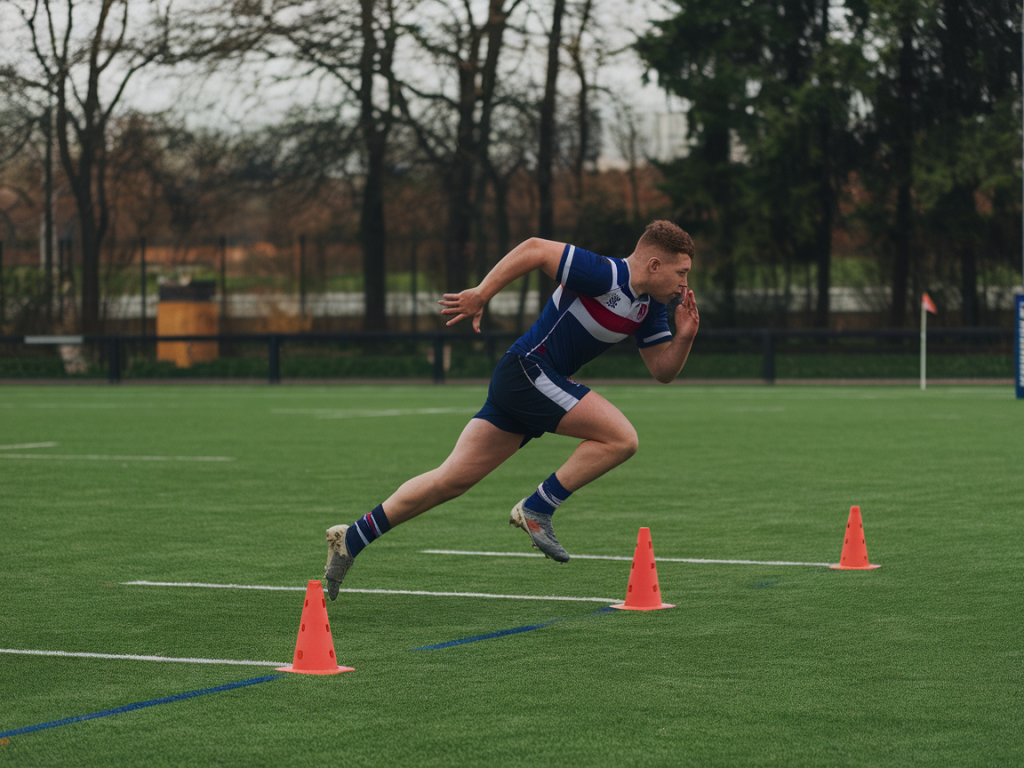
If you’re a grassroots rugby back trying to get quicker over 10m and 30m but you can’t add extra gym sessions to an already stacked schedule, I’ve put together a practical two-month plan that works inside your normal training week. This is the program I’d use with a local club: minimal equipment, clear progressions, and sessions embedded into field training so you don’t need to lift more or double up on gym time.
Why focus on 10m and 30m?
I prioritise the 10m and 30m because they represent two different match-use domains. The 10m is about initial explosiveness — beating a defender at the line, getting out of contact, or creating separation in a first step. The 30m tests top-end speed and the ability to sustain an attacking sprint in open play. Improving both makes you a more dangerous back.
Principles that guide the program
- Specificity: Train sprint mechanics and acceleration in conditions that mimic match situations.
- Quality over quantity: Short sessions with maximal or near-maximal efforts. Avoid volume that causes technical breakdown.
- Integration: Use part of regular training sessions rather than adding standalone gym work.
- Progressive overload: Increase intensity, technical demand or complexity week-to-week, not simply repetitions.
- Recovery and DMV (Daily Movement Variability): Sleep, hydration and light recovery work matter as much as the sprints themselves.
How I structure sessions (twice per week on-field)
I recommend two quality sprint sessions per week — one focused on acceleration (0–10m) and one on speed and transition (10–30m). Keep each session short (15–25 minutes of drill/sprint work) and place them early in sessions when players are fresh.
- Warm-up (8–10 minutes): dynamic mobility, A-Skips, B-Skips, straight-leg bounds, and 2–3 submax accelerations of 20m to prime technique.
- Main work (10–15 minutes): focused sprints/drills: short accelerations for one session, longer build to 30m for the other.
- Technical reinforcement (5 minutes): resisted sprint (band), sled/partner push, or overspeed glide if available — always light, 1–2 sets.
- Cooldown (5 minutes): walking, light mobility and quick feedback on technique.
Session A — Acceleration focus (0–10m)
This session tweaks first-step and horizontal force production using starts and short bursts.
- Warm-up as above.
- Drill: 3 x 10m falling starts (leaning forwards, one explosive step) — full recovery (90–120s).
- Drill: 4 x 10m from 3-point start (simulate contact shape) — full recovery. Emphasise low hips, long first step.
- Drill: 3 x 15m efforts with a focus on staying low through first 8m, then relax into upright running (120s recovery).
- Accessory: 2 x 15m resisted band sprints or partner sled (light resistance) — reinforce horizontal force.
Session B — Transition to top speed (10–30m)
This session looks at the ability to accelerate out of the first ten then transition to efficient upright mechanics for 20–30m.
- Warm-up as above.
- Drill: 3 x 30m build runs (first 10m at 90% intent, then accelerate through 30m) — full recovery (2–3 minutes).
- Drill: 4 x flying 20s (10m jog lead-in then 20m maximal) — focuses on maximal speed mechanics; full recovery.
- Drill: 2 x 40m efforts from standing with emphasis on relaxation and arm rhythm from 20–30m.
- Accessory: single-leg hops or bounding 2 x 6 reps for elastic strength (light intensity).
Weekly pattern
I embed these sessions into a typical rugby week like this:
- Monday: Technical session / contact (easy day) + Session A or rest depending on intensity
- Wednesday: Session A (acceleration) or club midweek field practise
- Friday: Session B (speed transition) incorporated before tactical work
- Saturday: Match
- Sunday: Recovery
8-week progression table
| Week | Session A (accel) | Session B (speed) |
|---|---|---|
| 1 | 3x10m falling, 4x10m 3-point, 2x15m resisted | 3x30m build, 4x flying 20, 2x40m standing |
| 2 | 4x10m falling, 4x10m 3-point, 2x20m resisted | 3x35m build, 4x flying 20, 2x40m relaxed |
| 3 | 5x10m falling, 4x12m from low start, 2x20m resisted | 4x30m build, 4x flying 20, 2x45m |
| 4 | 5x12m falling, 4x12m 3-point, 2x2x10m band sprints | 4x35m build, 4x flying 25, 3x40m |
| 5 | 4x10m max intent, 4x15m resisted, single-leg bounding | 3x40m build, 4x flying 25, 3x50m relaxed |
| 6 | 4x10m falling, 3x15m from low start, 2x20m resisted | 3x35m build, 4x flying 20, 2x40m |
| 7 | 3x8m explosive starts, 4x12m uphill (if available), light resisted | 2x30m max, 3x flying 20, 2x40m - tapering volume |
| 8 | Taper week: 3x10m technical starts, 2x15m easy | Taper week: 2x30m controlled, 2x flying 15, test days |
Testing and tracking
I test at week 0, week 4 and week 8. Use a simple stopwatch or phone apps (like MySprint or RaceTime). Mark a 10m and 30m flat, firm area, and take 3 attempts with full recovery — best time counts. Record perceived exertion and note technical cues like hip height and foot strike.
Technical cues I coach every rep
- Low, forward lean for first 8–10m; drive through the toes.
- Short, powerful first two steps then gradually lengthen as speed builds.
- Relax shoulders and hands; maintain high arm turnover without tension.
- Look 10–15m ahead, not at the feet.
Recovery, nutrition and sleep — non-negotiables
You won’t get faster if you’re always tired. I ask players to prioritise:
- 7–9 hours sleep per night.
- Protein intake across the day (20–30g per meal) to support neuromuscular recovery.
- Hydration; small amounts regularly through training.
- Active recovery the day after matches (light cycling, mobility) to reduce residual fatigue.
Minimal equipment and useful extras
This plan works with just cones and a partner. Useful extras if you have them: a light resistance band, a mini-sled, and timing gates or a good phone app for accurate measurement. Brands I’ve used at grassroots level include SKLZ for bands and MySprint apps for timing — but you can get great results with nothing more than a stopwatch and consistent effort.
Common mistakes to avoid
- Doing too many sprints in one session — quality is king.
- Neglecting warm-ups — sprinting cold breaks technique and increases injury risk.
- Over-resisting with sleds/bands — the goal is technical carryover, not brute force.
- Chasing numbers and skipping technique work — faster times follow efficient mechanics.
If you stick with this structure, monitor progress, and keep recovery in check, you’ll almost certainly see faster 10m and 30m times without adding gym hours. I use variations of this at club level and find players gain immediate benefits in both training and match situations — cleaner first steps, better line breaks, and more confidence in open-field sprints.