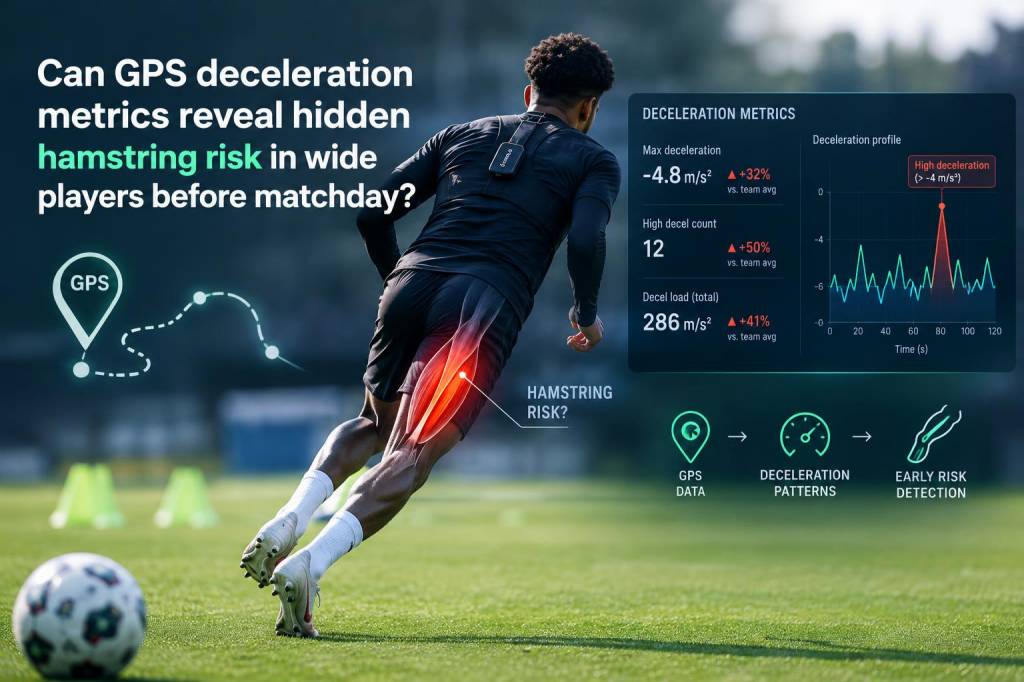
I have grown more interested in deceleration data over the past few seasons than in almost any other sprint metric. Acceleration gets the spotlight because it looks explosive and easy to celebrate, but in match preparation I often find that the real warning signs hide in the moments when a player must brake, absorb force, and re-accelerate under pressure. That is where GPS deceleration metrics can become especially useful for wide players, who live in the most demanding corridor of the pitch: repeated high-speed runs, sharp changes of direction, chasing recoveries, and short bursts that often end with a violent stop.
The question I keep asking in my own work is simple: can deceleration metrics reveal hidden hamstring risk before matchday? My answer is yes, but only if I use them carefully and never treat them as a crystal ball. A GPS unit does not diagnose tissue strain. It does not tell me that a hamstring injury is about to happen. What it can do is show me when a player’s mechanical load is drifting into a pattern that deserves attention. For wide players, that pattern can be especially revealing because their role blends sprint volume with repeated braking and re-acceleration in tight time windows.
Why wide players deserve separate attention
Wide players are not just running faster than everyone else. They are often performing a unique mix of work that stresses the posterior chain in a way central players may not experience as often. A winger or wide midfielder can spend long spells scanning, holding width, and timing a run, then suddenly explode into a full-speed action before needing to decelerate near the touchline, turn back inside, or check a run to receive a pass. That stop-start rhythm matters because hamstrings are heavily involved in controlling the leg during late swing and stabilising the body during braking.
When I review training or match data, I look beyond pure distance or top speed. A wide player may appear to have a manageable load because the total metres are not outrageous, yet the session may contain a dense cluster of intense decelerations, rapid directional changes, and sprint exposures with very little recovery. That is exactly the kind of hidden workload that can slip under the radar if I only focus on headline numbers.
In practical terms, a player can have a low total running volume and still carry a high neuromuscular cost. That cost may not show up as soreness until later, and it may not be obvious in a basic wellness report. This is where deceleration metrics can complement the usual workload picture.
What I actually mean by deceleration load
Deceleration load is not one single number, at least not in a meaningful performance sense. Different systems define it differently, and that is important. Some platforms count deceleration efforts above a certain threshold, while others estimate load from braking intensity, frequency, or cumulative magnitude. In my own process, I care less about the label and more about the pattern behind it.
For example, I pay attention to:
- How many hard decelerations a player completes in a session or match
- How close those efforts are to each other
- Whether decelerations occur after repeated sprint exposures
- Whether a player is braking while already fatigued
- Whether one side of the body is taking more load than usual
That last point matters more than people often think. If a winger is repeatedly decelerating after curving runs or cutting inside from the same side, the loading can become asymmetrical. I do not treat asymmetry as a problem on its own, but if it appears alongside rising braking load, low readiness, or recent hamstring history, I start to pay much closer attention.
Why hamstrings are vulnerable during braking
Hamstring risk is commonly discussed in relation to sprinting, and that is absolutely valid. During high-speed running, the hamstrings work hard to decelerate the lower leg and help prepare for ground contact. Yet I think deceleration deserves equal respect because braking changes how force is absorbed through the hip, knee, and ankle system. When a player decelerates aggressively, the body must manage a large horizontal force while maintaining control of posture and stride length.
I have seen players who look fresh during the opening part of a session but lose quality in repeated braking tasks. Their steps get slightly longer, their trunk position changes, and their ability to absorb force cleanly begins to fade. That does not mean injury is guaranteed, but it tells me that tissue tolerance may be under pressure. If hamstrings are already carrying residual fatigue from previous sprint exposure, this extra braking demand can push them closer to a tipping point.
The key idea is that hamstring risk is rarely caused by one isolated event. It is usually an accumulation story. Deceleration metrics help me see part of that story earlier.
What I look for before matchday
In the days before a match, I want to know not only whether a wide player has trained, but what kind of work they have completed. A standard session may look harmless on paper, yet the GPS output can show a spike in deceleration count, braking intensity, or acute load relative to the player’s recent baseline. That spike is often more important than the raw total.
My decision-making becomes sharper when I compare the current week with the previous three to six weeks. If a player is suddenly doing more sharp braking than usual, especially after a lighter block or during a return-to-play phase, I become cautious. A sudden jump in deceleration exposure can mean the player is being asked to cope with match-specific demands before the tissues are fully ready for them.
I also look at context. A wide player who has completed several high-speed exposures across two sessions may appear robust, but if those sprints were followed by repeated decelerations in tired state, I treat that as a very different picture from clean, well-spaced exposures. Fatigue changes mechanics. Mechanics change tissue stress. That chain matters.
What GPS can tell me and what it cannot
GPS is useful, but I never let it pretend to be more precise than it really is. It can show trends, not certainty. It can flag rising load, but it cannot measure tissue condition directly. That means I always combine it with other information: player feedback, sprint quality, movement quality in drills, medical notes, and my own coaching observation.
Here is the balance I try to maintain:
| Signal | What I learn | What I do not assume |
|---|---|---|
| Rising deceleration count | Braking demand is increasing | Injury is inevitable |
| Deceleration spike after a light week | Load jump may be too abrupt | Player cannot handle any intensity |
| Repeated braking after sprints | Fatigue may be affecting mechanics | Hamstring strain is already present |
| Asymmetrical braking pattern | One side may be carrying more stress | That side is definitely injured |
This is why I like GPS as part of a wider monitoring system rather than as a standalone alarm. If a player has a moderate braking increase but feels sharp, sleeps well, and moves cleanly, I may simply adjust volume. If the same data arrives with stiffness, poor jump output, or repeated complaints about tightness, I become much more conservative.
My favourite practical use case
The most useful scenario I have seen is not when GPS predicts a hamstring injury outright, but when it helps me alter a session before matchday. Suppose a wide player has had two strong field sessions, both featuring high sprint output and a large number of intense decelerations. On paper they may still be available. Yet if their recent history shows previous hamstring problems, or if they are coming back from a layoff, I can use the data to reduce the next exposure without stripping away all sharpness.
That might mean shorter repeat sprints, fewer maximal braking reps, or more controlled pattern work. I am not trying to make the player soft. I am trying to keep the neuromuscular system fresh enough to perform at match intensity without crossing the line. The best part is that players usually understand this when I explain it in performance language rather than injury language. They know that being a little undercooked is better than being unavailable.
What makes a deceleration warning more believable
I trust deceleration metrics more when several signs point in the same direction. In my experience, the warning becomes more credible if I see:
- A clear rise in braking load compared with the player’s normal pattern
- High-speed running paired with frequent stops and turns
- Reduced movement quality during later reps
- Past hamstring issues or recent return from injury
- Subjective fatigue or tightness reported by the player
If only one of those signs is present, I stay observant. If four or five show up together, I start planning differently. That is where data becomes action rather than decoration.
Why the best answer is still individualised
One wide player may tolerate a huge amount of deceleration work and look better with more exposure. Another may need a much tighter progression because of previous tissue history, running style, or match role. I never assume that one threshold suits everyone. Some players are naturally efficient brakers. Others are more elastic, more aggressive, or simply more vulnerable when exposed to repeated stop-start demands.
That is why I prefer to think in terms of individual baselines. A player’s own normal pattern matters more than a generic team average. If a winger usually handles twelve to fifteen hard decelerations in a session and suddenly jumps to twenty-two, I take that seriously even if the number does not look outrageous in isolation. Relative change is often more informative than absolute volume.
For me, the most useful part of GPS deceleration monitoring is that it changes the conversation before matchday. Instead of asking only whether a player is fit, I can ask whether the player is prepared for the exact demands they are about to face. That distinction has helped me avoid unnecessary risk, sharpen session design, and better protect wide players who live in the most explosive parts of the game.