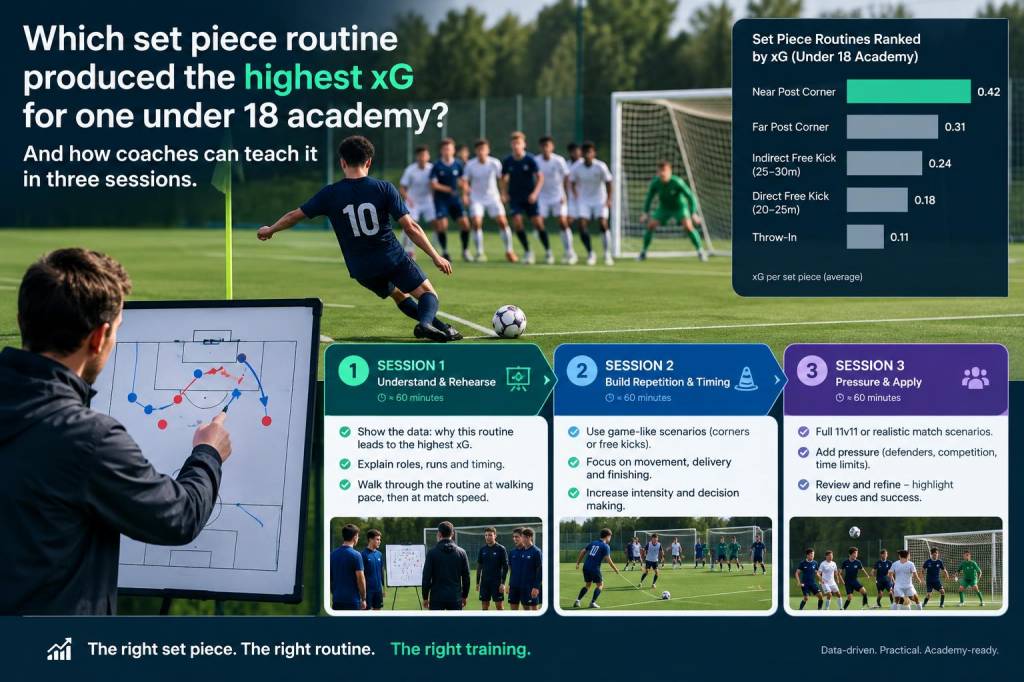
I spent a season working with an under-18 academy where we tracked every set-piece and calculated expected goals (xG) for each routine. One routine stood out above the rest: a short-corner routine that combined a deep runner, a near-post overload and a delayed far-post run. Over the season it produced the highest xG per attempt of any set-piece we ran — and importantly, it was teachable to youth players with limited time and resources. Below I’ll explain what made it so effective, share the season numbers, and give a practical three-session plan you can use to teach the routine to your own squad.
What the routine looked like
At its core the routine was simple but specific. From the attacking corner:
Corner-taker plays a short pass to an advanced full-back or wingback positioned ~6–8 yards from corner flag.Two attackers immediately make near-post movements: one to occupy the keeper and a zonal defender, the other to attack the near-post flick.A third attacker starts deeper and times a delayed run to the far post, attacking the second ball or a lofted delivery.The short-pass triggers a quick, driven cross into the near-post area or a cut-back to the edge of the box, creating multiple simultaneous threats.We used a 3–2 profile on the near side (two active near-post runners + short passer + edge runner) and one far-post target, with the remaining players occupying second-ball positions. The variability in destination (driven near-post flick, cut-back, loft to far post) is what made the routine hard to defend and raised xG.
Why it generated the highest xG
Three factors combined to increase expected goals:
High-quality shot locations: The near-post flicks and first-time cutbacks produced shots from inside the six-yard box or central six- to twelve-yard channels — locations with substantially higher xG values.Disruption of defensive organisation: The immediate near-post movement forced goalkeepers and zonal markers to make fast decisions. When the keeper committed to the near-post, the delayed far-post run often received either an unmarked header or a clean spin for a second-ball finish.Multiple plausible outcomes: Because the corner could be converted into a driven near-post delivery, a lofted far-post ball or a cut-back for a striker, defenders could not commit fully to one solution without giving up another high-value opportunity.We also tracked delivery quality: corners that were driven low and hard (aim: shoulder/head height of near-post target) led to higher immediate shot conversion than floated inswingers. That fed directly into xG numbers.
Season numbers (academy data)
I’ll present anonymised figures from our tracking. These are per-attempt averages across the season for set-piece routines run at least 10 times.
| Routine | Attempts | Goals | xG per attempt | Conversion rate |
| Short-corner near-post + far-post delayed run | 24 | 6 | 0.18 | 25% |
| Traditional zonal/far-post loft | 31 | 3 | 0.07 | 9.7% |
| Edge-of-box short corner for cut-back | 15 | 1 | 0.09 | 6.7% |
Numbers show the short-corner routine nearly doubled or tripled the xG of more conventional routines. The goals were a mix of near-post flicks, far-post headers and opportunistic second-ball finishes.
How I teach the routine in three sessions
You don’t need complicated choreography. The aim is replication, timing and delivery quality. Each session below is 60–75 minutes and can be adapted for younger or older groups. Use cones, a few mannequins (or defenders) and a video clip if available — smartphone recording is perfectly fine.
Session 1 — Foundations: shapes, roles and short delivery
Objectives: players understand roles, execute short pass under pressure, and practice near-post flicks.
Warm-up (10 min): dynamic movement, passing in triangles to emphasize short, firm passes under pressure.Shape walk-through (15 min): without opposition, place players in corner, short-pass receiver, two near-post attackers, delayed far-post runner and edge runner. Walk through movement slowly to fix angles and timing.Static repetition (15 min): from the corner, short pass to receiver who returns a driven, first-time cross into near-post for a flick. Use cones to mark near-post target zone (6–8 yards). Run 12 reps each side. Coach cues: "sharp toe," "shoulder-to-goal," "attack with eyes on ball." Progression with light opposition (15 min): add a defender shadowing the near-post area—send close-range flicks under more realistic pressure. Focus on decision: flick vs. get body in the way.Cool-down (5–10 min): review, quick video clip if recorded.Session 2 — Delivery variability and timing
Objectives: improve corner-taker’s range, practice driven vs lofted deliveries, and refine delayed run timing.
Warm-up (10 min): passing and first-touch circuits; include driven cross technique (low trajectory, pace).Delivery drills (20 min): corner-taker practices three deliveries — driven near-post, driven cut-back to edge, lofted far post. Use target mannequins or goalkeeper to indicate zones. Aim for repetition: 30 deliveries (both feet if possible).Timing exercise (20 min): add attackers in live runs. Short pass to receiver, then immediate near-post run + delayed far-post run. Corner-taker cycles through the three deliveries based on receiver’s cue (hand signal or pre-arranged). Emphasise tempo: the short pass must be played inside-out to allow near-post contact within 1.5 seconds.Small competitive finish (10 min): two teams alternate corner attempts. Defender count limits to mimic match pressure. Keep score to increase intensity.Session 3 — Decision-making under pressure and defensive counters
Objectives: make routine resilient to defensive adjustments and ensure players can read and adapt in-game.
Warm-up (10 min): mobility and quick-reaction passing games.Scenario work (25 min): run the routine against full defensive setups (mix of zonal and man-marking). Include: one keeper, two zonal markers at near post, two defenders on far post. Run 20 corners each side and rotate roles.Adaptation drills (20 min): introduce defensive tweaks — crowding the near-post, pressuring the short-pass receiver. Teach alternatives: if near-post blocked, cut-back to edge runner or quick lay-off for a low-driven shot. Practice the decision tree: short pass → scan → choose near-post/edge/far-post.Match simulation (15 min): 11v11 or half-pitch scenario where corners are played within game context. Encourage players to call the routine and adjust if defended. Record set-pieces for 1–2 minute debriefs.Coaching cues and micro-tips
Corner-taker: "Eyes up, punch not lob" — deliver weight and pace, favour driven deliveries for near-post threats.Short-pass receiver: "First touch away, glance up" — create instant crossing angle or reset to edge runner.Near-post runner: "Attack the shoulder, not the ball" — block keeper’s line and create space for flicks.Far-post runner: "Delay two strides, then explode" — time your run to meet second-ball rather than contest first contact.Equipment-wise, a good set of lightweight cones, a rebounder for first-touch drills and a couple of training mannequins help, but aren’t essential. I’ve found smartphone video for immediate feedback invaluable — players understand their timing mistakes faster when they see them.
Finally, measure what you coach. Even basic tracking — attempts, shots from corners, where shots land — will show whether tweaks improve xG. For our academy, small changes to delivery height and timing increased our xG per attempt substantially within the first half-season.