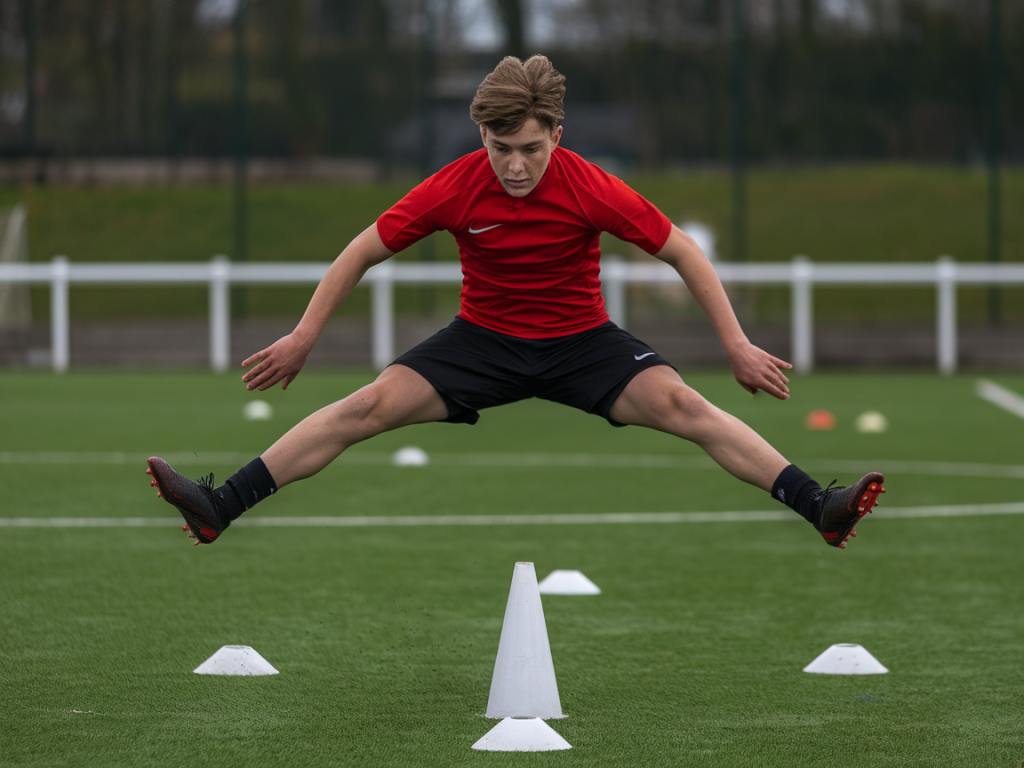
I remember the first time a teenage striker asked me to help him get faster over the first 10 metres. He wanted the tiny margins — the 0.02–0.05s differences that separate a successful first touch or beating a defender to a loose ball. Over seasons of coaching football and rugby, and from testing drills on muddy pitches, I’ve developed a compact, pitch-based plyometrics approach that’s realistic for club sessions and school fields. The aim I use with young forwards is modest but meaningful: add around 0.03 seconds to a 10m sprint time using only exercises you can do on the pitch with minimal gear.
Why 0.03s matters (and why plyometrics?)
0.03s sounds tiny on paper. Over 10m, however, it can be the difference between being reached by a defender or getting clean contact on the ball. For teenage athletes, small neuromuscular gains translate quickly into real-game advantages.
Plyometrics target the stretch-shortening cycle (SSC) — the rapid transition from eccentric (lengthening) to concentric (shortening) muscle action. Improving SSC efficiency improves rate of force development (RFD), which is crucial for the explosive first steps of a sprint. The beauty of pitch-based plyometrics is that they’re low-cost, scalable, and transferable to the sport context: you’re training in the same environment where acceleration matters.
Who this works for (and who it doesn’t)
This approach is designed for teenage strikers roughly aged 14–18 who:
Do not use high-impact plyometrics if the athlete has current knee, ankle, or lower-back injuries, or if they haven’t yet developed basic control and landing mechanics. When in doubt, consult a physio or strength coach.
Principles that guide my sessions
I keep sessions short, specific, and sport-contextual. The five pillars I follow:
Pitch-based plyometric exercises I use
All these exercises require minimal equipment (cones, a small hurdle or a 20–30cm box if available). Start each session with a dynamic warm-up and sprint prep — 5–8 minutes of leg swings, A-skips, high knees, and 2–3 submaximal 20m sprints.
Sample 6-week progression (2 sessions/week)
| Week | Session A | Session B |
|---|---|---|
| Weeks 1–2 | ||
| Weeks 3–4 | ||
| Weeks 5–6 |
How to integrate with football training
Keep plyo sessions separate from heavy technical or tactical days. I schedule them on the same day as light technical work or the day after a rest day. Never do intensive plyos before a match. For development-age players, limit to 6–8 weeks blocks with follow-up maintenance sessions (1/week) during season.
Technical cues I use
How I measure progress
Consistency in testing is crucial. I use electronic timing gates where possible; if not available, a marked 10m with a phone camera filmed at 60fps can help. Test once every two weeks after a rest day and before any heavy training that day. Watch for a progressive drop in 10m time — if someone is consistently shaving 0.01–0.02s per test, a 0.03s improvement across 6–8 weeks is realistic.
Common pitfalls and how to avoid them
Minimal equipment suggestions
You don’t need fancy gear. A set of cones, a low plyo box (20–30cm), and mini-hurdles (or folded training bibs over cones) is sufficient. If you have an Apple Watch or phone, record 10m sprints for consistent timing.
If you want, I can adapt this plan to a specific player profile (age, bodyweight, injury history) or create a printable field map and session sheet for your coaching folder. On Samsophsaints Co, I favour practical, evidence-informed methods you can implement tomorrow — this is one such programme I’ve used with teenage strikers to get those precious hundredths back when it matters most.