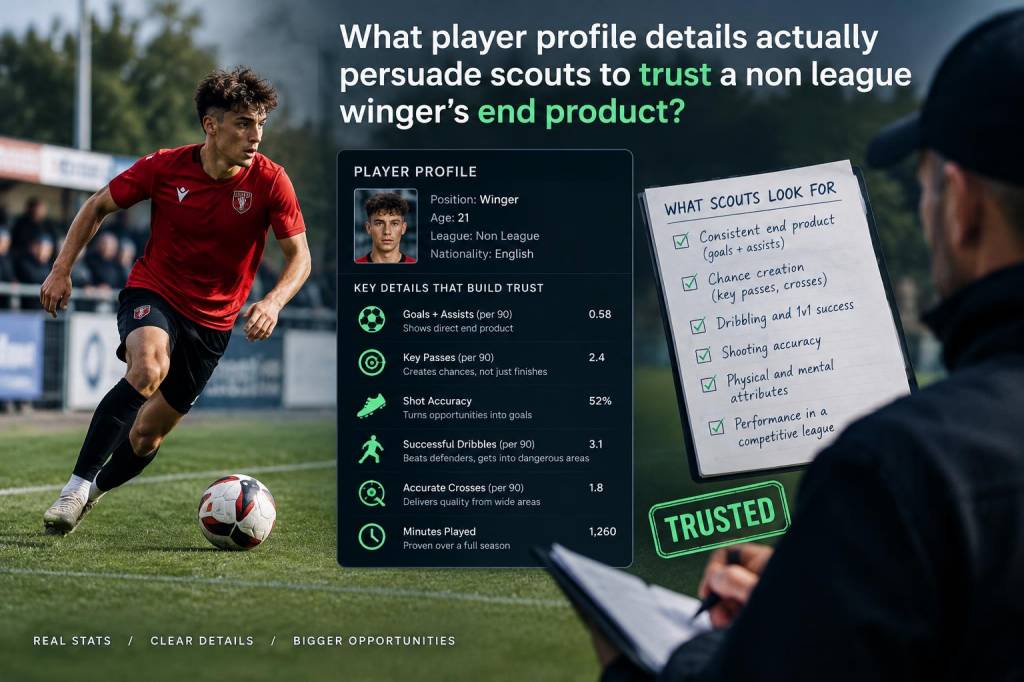
What I Look for When a Non-League Winger Tries to Convince Me
When I watch a non-league winger, I am rarely persuaded by a single flash of quality. A clipped cross, a driven shot, or one clever dribble can catch my eye, but it does not earn trust on its own. What matters to me is whether a player can repeat useful actions under pressure, against different defenders, in different phases of a match, and still protect his numbers when the game turns messy. Scouts feel that same tension. They are not only asking, “Can he do it?” They are asking, “Can I believe this end product is real?”
For me, end product is not just goals and assists. It is the chain of evidence that sits behind them. I want to know whether a winger creates chances from reliable habits, whether he makes strong choices near goal, and whether his delivery holds up when the opposition adapts. A player profile becomes persuasive when it connects output with process. Without that link, impressive stats can feel fragile.
Repeatability Matters More Than One Highlight Reel
Non-league football can produce brilliant moments that look better on video than they do in context. A winger might beat a tired full-back once, or hit one outstanding cross from a dead ball situation, and suddenly people start talking about “natural quality.” I am much more interested in repeatability. If a player creates from the same type of action again and again, I start trusting it.
That is why I like to see profile details that show patterns rather than isolated events. A scout wants evidence that the winger can consistently win half a yard, receive under pressure, and deliver with purpose. If a player racks up chances from open play, set pieces, and transition moments, it suggests flexibility. If his output only comes from one narrow situation, I become cautious.
In practical terms, I would rather see a winger who delivers five useful crosses every match than one who produces one spectacular assist and disappears for long periods. Reliability builds confidence. In my experience, scouts trust players who give them less uncertainty.
Which Numbers Actually Carry Weight
Raw totals matter, but only if I know what sits underneath them. Goals and assists are still important, yet I want more detail before I commit to a strong opinion. A winger’s profile becomes much more convincing when it includes progressive actions, chance creation, shot quality, and the locations from which those actions happen.
I pay close attention to whether output comes from open play or dead balls, because that changes how I judge a winger’s transferability. A player who creates six assists from corners and free kicks is useful, but a player who repeatedly beats his marker and cuts the ball back from the byline offers a different level of attacking threat. I also want to see whether his final action is consistent across home and away matches, against stronger and weaker opponents, and late in matches when legs are heavy.
Some details I find persuasive in a winger profile include:
- Chance creation from open play rather than only set pieces
- Successful dribbles in dangerous areas rather than harmless wide zones
- Cross completion with clear target selection
- Shots on target from sensible locations
- Progressive carries that move play into advanced areas
- Consistency across a full season rather than a short hot streak
If those numbers are paired with video clips that show sensible decisions, I begin to trust the player much more quickly. If they are not, I assume he may be living off variance.
Decision Making Near Goal Tells Me a Lot
I have coached enough attackers to know that talent without decision making can stall very quickly. For a winger, end product often comes down to a handful of moments near the penalty area. Does he cross early, cut back, drive inside, or shoot? Does he choose an action that helps the team, or one that flatters his ego?
When I study player profiles, I look for signs that the winger understands game state. If his team is chasing a goal, can he speed up possession and attack space with intent? If his side is protecting a lead, does he still make smart decisions and avoid reckless turnovers? Scouts trust players who make mature choices, because mature choices usually travel well when levels rise.
I also value evidence that a winger can vary his final action. A player who only wants to dribble to the byline becomes predictable. A player who can cross early, combine inside, and attack the far post becomes harder to defend. Variety does not mean chaos. It means having more than one route to end product.
Body Shape, Delivery, and Technical Details
Small technical details often explain whether a winger’s numbers will survive at a higher level. A strong profile should tell me something about body shape in crossing, first touch under pressure, and the quality of his delivery from different zones. I care about whether he can hit the ball with pace and accuracy while moving at speed, because that is usually what separates a decent non-league wide player from a prospect who might step up.
When I watch footage, I notice the way he opens his hips before crossing, whether he gets his head up early, and whether his touch sets up the next action or forces him to recover. A winger who needs several touches to prepare every delivery will struggle when opponents close space faster. One who can receive on the move and release quickly gives me more confidence.
Technical consistency matters in both feet as well. A profile looks stronger when a winger can threaten from either side, or at least when his weaker foot is functional enough to keep defenders honest. I do not need a player to be symmetrical. I do need him to be believable. A scout wants to know that a defender cannot simply show him one direction and remove half of his game.
Context Is Often Missing, and That Is a Problem
One reason scouts can hesitate is that many player profiles strip away context. A winger may have strong numbers, but were those numbers built against deep defensive blocks, struggling teams, or tired opposition late in matches? Did he play as a pure touchline winger, an inverted forward, or part of a front two? Did he receive good service, or did he create almost everything himself?
I trust a profile more when it explains role and environment. If a player has been asked to stay wide and stretch play, his chance creation may look different from that of a winger who cuts inside on every attack. If he has spent half a season in a poor team, his final numbers may understate his ability because his supply line was weak. Scouts understand context, and a good profile should help them do that work faster.
That is why I like match notes that describe the type of chances a winger creates. Are they cut-backs from the byline, whipped crosses toward runners, slipped passes after combination play, or individual carries that end in a shot? Those details help me decide whether output was repeatable football intelligence or simply a lucky run of events.
Off-Ball Work Can Make End Product More Believable
I know some people focus only on the ball, but I rarely trust a winger’s output unless his off-ball habits support it. Movement matters. If he consistently finds pockets between full-back and centre-back, I begin to see a player who understands timing. If he sprints to offer a return pass after releasing the ball, that tells me he is connected to the attack, not just waiting for a moment to shine.
Defensive work also influences how scouts interpret a winger’s profile. A player who presses with purpose, tracks back when needed, and helps his full-back can earn more trust than one who only contributes in possession. That does not mean I expect every winger to be a workhorse. It means I value complete habits. Coaches like players who fit systems, and scouts know that a productive winger who also works intelligently becomes easier to place in a higher-level squad.
Sometimes the smallest off-ball clue gives the biggest signal. A well-timed run to the near post, a recovery sprint after a turnover, or a smart reset into midfield can say more about football intelligence than a single assist. These actions may never dominate a stat sheet, but they make an end product profile more convincing because they show intention, discipline, and understanding.
What I Want a Scout Report to Include
When I build or read a profile on a non-league winger, I want more than a list of numbers. I want a story supported by data and observation. I want to know what kind of chances he creates, when he creates them, and whether his output survives when matches change shape.
| Profile Detail | Why It Persuades Me |
|---|---|
| Open-play chance creation | Shows attacking quality that is not tied to set pieces |
| Successful actions in dangerous zones | Suggests real threat near goal rather than harmless possession |
| Crossing variety | Proves he can hurt opponents in different ways |
| Decision making under pressure | Indicates maturity and transferability |
| Consistency across several matches | Reduces the risk of chasing a short-term spike |
| Context about role and opposition | Makes the output easier to trust |
When those elements line up, I start to believe that a winger’s end product is not an accident. That is the point where scouts usually lean in. They are not buying fantasy. They are buying evidence.
What Makes Me Trust a Player Most
If I had to name the single detail that persuades me most, it would be consistency in repeatable actions. A winger can have a burst of assists, but if he reaches those numbers through unstable habits, I stay cautious. If he creates through the same strong decisions, the same technical execution, and the same attacking intent week after week, I trust him much more quickly.
I also value honesty in the profile itself. Strong player profiles do not hide weaknesses. They explain them. Maybe the winger is explosive but not yet strong enough in duels. Maybe his left foot is limited. Maybe his finishing lags behind his chance creation. That kind of clarity actually helps me trust the overall assessment, because it shows someone has watched the player carefully rather than just praising the stats.
In my experience, scouts are persuaded by profiles that answer a simple question: if this winger moves up a level, will his end product still hold up? The closer the evidence gets to that answer, the more likely they are to trust him.