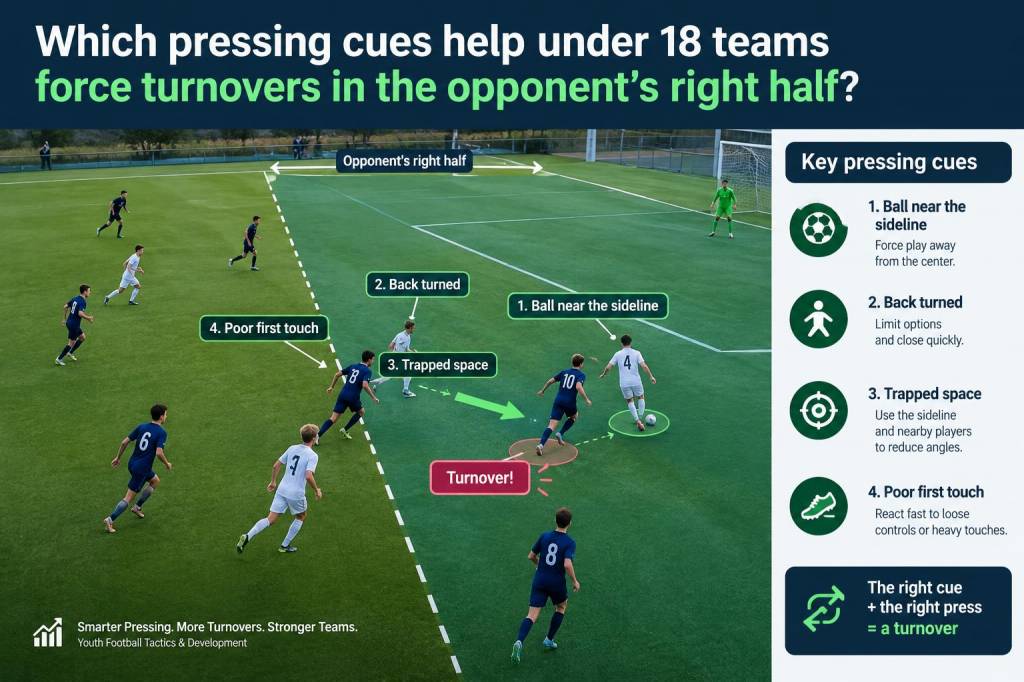
When I work with under-18 teams, I rarely talk about pressing as a single action. I talk about cues, because young players press better when they know exactly what should trigger the jump, who should lock the passing lane, and where the ball should be forced. If I want turnovers in the opponent’s right half, I am not just asking for energy. I am asking for a shared reading of body shape, touch direction, support angles, and near-side pressure.
For me, pressing in that zone starts before the first duel. I want my players to recognise moments that make the opponent vulnerable: a poor first touch near the touchline, a receiver facing his own goal, a full-back with no clear inside option, or a centre-back who has stepped wider than the rest of the line. In youth football, those details appear constantly, and they are often enough to create a turnover if my team reacts together.
Why I focus on the opponent’s right half
I like this zone because it gives me a clear reference point for pressing organisation. When the ball is on that side, my team can shape the trap around the sideline, the touchline, and the nearby central lane. That gives us a natural set of boundaries. In my experience, young teams often press harder when they can see a spatial problem rather than a vague instruction to “press high.”
The opponent’s right half also creates useful patterns. Many right-sided build-up structures rely on a full-back, a wide midfielder, and a centre-back or pivot offering short support. If I can disrupt the first or second pass in that triangle, I can force a rushed decision. That is where turnovers usually come from at this age: not from long, dramatic chases, but from a controlled squeeze that removes the easy outlet.
The pressing cues I trust most
When I coach under-18 players, I keep the cues simple enough to remember in match speed. I want them to look for a few reliable signals:
- Open body shape facing the touchline: if the receiver is already angled away from the centre, I know the inside escape is weaker.
- Heavy or bouncing first touch: a poor first contact gives my nearest presser a green light to attack the ball.
- Back pass under little pressure: when the opponent recycles without tempo, I use that moment to step up as a unit.
- Head down before receipt: if the player is not scanning, I expect a limited next action and I can compress space quickly.
- Support too far away: when the nearest passing option is late or distant, the ball carrier becomes isolated.
- Square pass into a marked player: a pass across the face of pressure is often the trigger for the nearest trap.
I also train my players to read the passer, not only the receiver. A pass that arrives with too much pace, too little angle, or too little disguise often creates the exact moment I want. Under-18 players can be brilliant at noticing the ball, but they need to learn to notice what the ball tells them.
My pressing triggers from the front line
The first pressing action matters because it decides whether the opponent feels calm or rushed. I usually ask my front player to curve the run so that the opponent’s right-sided centre-back or full-back is shown outward. That run is not just about sprinting. It is about closing the inside lane first, then arriving in a way that blocks the return pass.
From there, I want one of three cues to start the full press:
- a receiver takes the ball with his back to goal and no clean turn;
- the full-back receives near the line with little room to play inside;
- the centre-back passes into a wide player who is already pinned.
As soon as I see one of those cues, I want my second and third pressers to move with conviction. If they arrive late, the ball escapes. If they arrive early without angle control, the opponent plays through us. So I coach timing as much as aggression.
How I shape the second and third pressers
In youth football, many pressing problems come from the second wave. The first presser may do a good job, but the next player arrives too straight or too deep. I want the second presser to protect the inside exit, while the third presser narrows the passing lane toward the nearest central option. That means we are not chasing the ball blindly. We are closing the opponent’s most useful routes.
When the ball is on the opponent’s right side, I like my nearest central midfielder to step with a clear job: take away the switch inside, stop the return pass to the pivot, and be ready for a loose touch. My wide midfielder on that side must be brave enough to jump, but also smart enough to avoid getting dragged too high too early. If we overcommit, we open the diagonal lane. If we delay, the opponent turns out. The right balance is what creates the turnover.
I often tell my players to imagine a shrinking box around the ball. Each press should make that box smaller, but no one should leave a door open. That idea is simple enough for U18 players and strong enough to shape a real collective press.
What I train in sessions
I like drills that make the cues visible. One of my favourite exercises is a small-sided build-out game with a forced right-side starting point. I give the attacking team a point for escaping pressure through the right half, and I give the pressing team extra reward for winning the ball within five seconds of the trigger. That creates urgency without chaos.
I also pause the session and ask players what they saw before the turnover. Usually they identify one of the same moments every time: a bad touch, a late support run, a square pass, or a receiver turning his hips toward the sideline. Once they learn to name the cue, they start to react earlier. That is where real improvement happens.
Another useful practice is a shadow pressing drill where I rehearse the starting positions without opposition. I place the front line, midfield line, and nearest full-back in relation to the ball, then I walk through the press shape step by step. Young players often understand the idea faster when they see the distances between lines.
| Cue | What I want from my team | Likely result |
|---|---|---|
| Heavy first touch near the line | Nearest presser attacks, support closes inside lane | Rushed clearance or turnover |
| Receiver facing own goal | Jump from front and midfield, block turn | Back pass or poor outlet |
| Square pass into marked player | Press as a unit, squeeze space behind ball | Loose touch, interception, or foul draw |
| Slow support from central midfielder | Wide player steps with confidence | Isolation and recovery win |
| Back pass under low pressure | Team steps up together | Opponent pinned deeper and forced long |
The body language I teach players to watch
Body language is one of my strongest tools because it often reveals the next action before the ball does. If the opponent’s right-sided player is looking down at the ball, that is usually a cue to accelerate. If his first touch points toward the sideline, I want my nearest players to squeeze him into that channel. If his shoulders open toward the centre, I want the inside lane closed immediately.
I also look at the support players. If the nearest teammate is static, I know the ball carrier may be under more pressure than it appears. If the nearest teammate starts moving too early, I know a wall pass may be coming. In both cases, my press can become more precise. That is why I keep telling players that pressing is not only about running. It is about reading intention.
Common mistakes I correct straight away
I see a few errors again and again with under-18 teams. First, players sprint at the ball without checking the cover behind them. That creates easy escapes. Second, they press as individuals rather than as a connected line. That leaves gaps between the first and second wave. Third, they keep chasing after the ball has already been played away. I always prefer a delayed collective step to a wild solo chase.
I also correct pressing angles. A straight run often lets the opponent play inside. A curved run is usually more useful because it protects one route while inviting the opponent into another. In the opponent’s right half, that often means showing play toward the line while sealing the return inside. When my players master that detail, our turnovers become much more frequent and much more controlled.
Finally, I remind them that pressing is a team action, not a mood. If one player goes and others stay flat, the press fails. If everyone moves on the same cue, the opponent feels the net close around him. That shared commitment is what I value most, because it turns a simple trigger into a real chance to win the ball high and attack immediately.