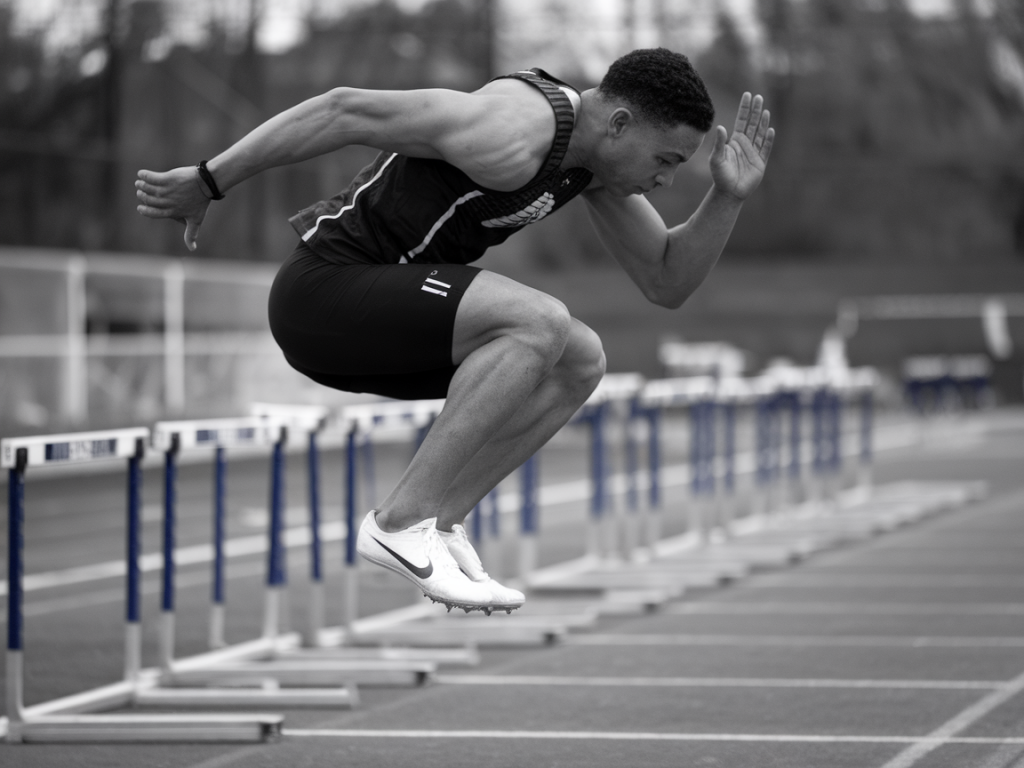
I’ve spent years on the training ground testing drills and collecting data, and one question keeps coming up: which plyometric exercises actually move the needle on 10m acceleration for sprinters and footballers? Short-distance acceleration is a unique blend of force production, technique and reactive ability. Plyometrics, when chosen and programmed correctly, target those qualities. Below I share the drills I use most, how I coach them, sample progressions and common pitfalls to avoid.
Why plyometrics for 10m acceleration?
Plyometrics develop the ability to produce force quickly — the stretch-shortening cycle (SSC). For a 10m sprint you don’t need maximal top-end speed: you need high horizontal force in the first 3–8 steps and an efficient rate of force development (RFD). Plyometrics improve:
Not all plyometrics are equal for this purpose. The best drills are those that mimic the force vector and timing of early acceleration.
My go-to plyometric drills for 10m acceleration
Below I list drills I program most often, with coaching cues and the reason I like them.
Coaching cues: long, powerful ground contacts; land softly but drive forward; emphasis on horizontal distance per bound. Why it works: Bounding increases horizontal force and teaches a long, powerful first half of the stance phase. Use single-leg bounds to address leg asymmetries.
Coaching cues: drive off front leg, keep torso upright, land quietly into the lunge. Why it works: Focuses unilateral triple extension and horizontal push-off similar to initial acceleration steps.
Coaching cues: minimise ground contact time, absorb on the balls of the feet, eyes forward. Why it works: Improves reactive strength and stiffness with small, frequent ground contacts.
Coaching cues: 3 bounds then accelerate for 6m; maintain forward posture into the run. Why it works: Smooth transition from horizontal plyometric action into sprint mechanics — very specific to 10m acceleration.
Coaching cues: low-load, vertical drive combined with forward lean; minimal deceleration on landing. Why it works: Adds overload to horizontal push without disrupting technique as heavy sleds can. Great for power transfer to sprint.
Coaching cues: step off, land quietly and immediately drive forward; avoid upright landing and braking. Why it works: Trains rapid absorption and powerful re-extension into a short sprint.
Programming: sets, reps and placement in a session
Plyometrics are high-intensity; quality matters more than quantity. Here’s a simple weekly template I use with athletes focusing on 10m acceleration:
| Session | Example drills | Volume |
|---|---|---|
| Speed session (2×/week) | Bounding into short sprints, drop-to-sprint | 4–6 reps × 3–4 sets (total 12–24 reps) |
| Power/strength day | Split squat jumps, weighted sled jumps | 3–5 reps × 3–4 sets per leg |
| Reactive/technique day | Hurdle hops, single-leg bounds | 6–8 contacts × 3–4 sets |
Key rules:
Progressions and how to move an athlete forward
Progress by increasing intensity, complexity or specificity — not just reps. A practical progression over 4–8 weeks might look like:
If an athlete lacks baseline strength, build that concurrently. Plyometrics amplify strength — but you need adequate eccentric and concentric strength first. I usually pair unilateral strength work (bulgarian split squats, Romanian deadlifts) once or twice weekly.
Coaching cues and technical points
Common mistakes and how to avoid them
Equipment and brand notes
You don’t need fancy gear but some items speed up implementation:
How I measure transfer
Transfer is everything. I test 10m sprints every 2–4 weeks and track contact times with force plates or contact mats when available. Anecdotally, athletes who do targeted horizontal plyometrics consistently see 0.03–0.06s improvements over 10m within 6–8 weeks, provided strength work is present too. Small gains matter in sprinting and football match situations where milliseconds and the first few steps determine success.
If you want, I can build a specific 6-week plyometric block for you or your team based on current strength levels and training frequency. Tell me the athlete’s baseline 10m time, squat strength or bodyweight, and training schedule, and I’ll draft a plan that keeps quality high and maximises transfer to the pitch.