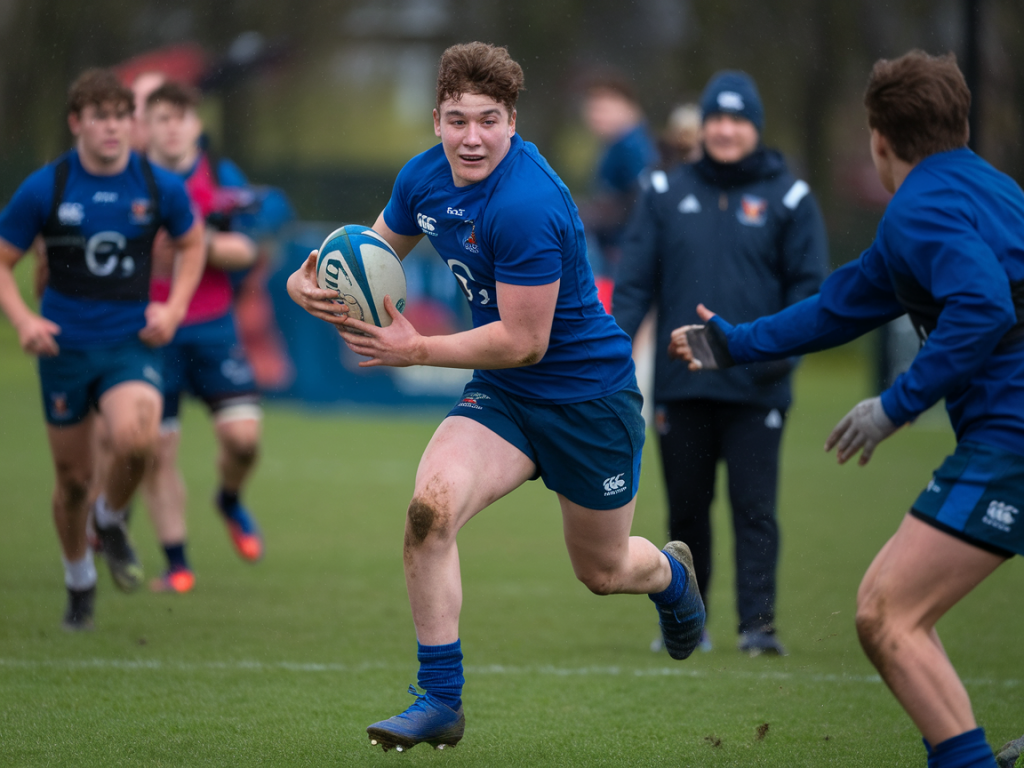
I’ll walk you through a six-session plan I use with teenage centres to build reliable contact technique and sharper in-game decision-making. The aim is simple: create a repeatable process that improves confidence in contact and shortens the time it takes a young centre to read, choose and execute options under pressure. These sessions are practical, progress from isolated technique to game-like context, and are designed to be delivered across two to three weeks depending on session frequency.
Why focus on centres?
As a coach who’s spent years on the grass with teenage players, I’ve seen centres asked to do more than any other backline position. They must carry into contact, protect the 10 or 12, make split-second decisions on whether to crash, pass, offload or create space, and they often face bigger, older opponents in contact. That’s why I split the work: technical contact mechanics first, then decision-making layered on top so the player doesn’t have to think about basics when the game speeds up.
Session overview (quick reference)
| Session | Primary focus | Duration | Key drill |
|---|---|---|---|
| 1 | Body shape & tackle/contact entry | 60 min | Carry-and-drive progressions |
| 2 | Ball security & contact transition | 60 min | Arm-wraps & solo contact circuits |
| 3 | Contact + support footwork | 75 min | Contact to pass/clear-out sequences |
| 4 | Decision-making under pressure | 75 min | 1v1/2v1 contact options game |
| 5 | Offload timing & leg-drive | 60 min | Controlled offload circuit with pads |
| 6 | Match simulation & assessment | 90 min | Conditioned match with video feedback |
How I structure each session
I like consistent blocks: warm-up (10–15 mins), technical block (15–20 mins), skill application (20–30 mins), conditioned decision-making or small-sided game (15–30 mins), and a debrief (5–10 mins). For teenagers, keep intensity high but volume moderate — recovery matters when learning new movement patterns. I use simple tools: tackle pads (Gilbert or Kooga are fine), tackle rings, cones, and a phone for video feedback. If you have access to GPS or heart-rate tech, track RPE and impact counts over the six sessions to spot fatigue or overload.
Session 1 — Body shape and contact entry
Objective: establish a powerful, safe contact posture and the timing of the shoulder-spear approach.
- Warm-up: dynamic mobility, A-skips, hip switches, neck rotations.
- Technique drill: stationary contact on pads. Focus cues — chin down, shoulder into target, hips behind shoulders, drive through the legs.
- Progression: 5m carry into a pad-holder with a 45° line. Centre lands on front foot, hits with shoulder, drives 2–3 explosive leg pumps and resists being pushed back.
- Coaching notes: use video to show front-on and side-on angles. Praise balanced landings and leg drive; correct upright posture immediately.
Session 2 — Ball security and contact transition
Objective: secure the ball into contact and transition quickly for recycle or offload.
- Warm-up: partner passing, evasion steps.
- Drill: “carry, brace, go” — player takes three momentum steps, meets a controlled tackle from pads, practices pulling the ball tight to the chest and delivering a quick handoff to a supporting player within 2 seconds.
- Drill variation: 1v1 where the centre takes contact, must either stand and offload or go to ground and present correctly. Use soft-headed tackling to reduce risk.
- Coaching cues: “chest to the ball, elbows tight, present low”. Emphasise eyes up as soon as ball is secured so decision-making starts early.
Session 3 — Contact into support and footwork
Objective: link contact to the next action (pass, clear-out, or carry again) with efficient footwork.
- Skill: contact-to-pass chain. Centre runs, takes a 1v1 contact, then immediately steps into a support lane and passes to a teammate moving into space.
- Introduce “blur” defenders — passive at first, then active — to increase scanning demands.
- Measure: count successful contact-to-pass completions across 10 reps. Aim for 80%+ by session end.
Session 4 — Decision-making under pressure
Objective: practice choice-making when options appear quickly.
- Game: 2v1 contact scenarios. The centre receives the ball with an outside defender and an inside chaser arriving. Options: take contact and offload, slice inside, or switch to support. Rotate roles frequently.
- Constraint: add a 3-second rule — centre must commit to an option within 3 seconds of contact. This enforces quick reading.
- Feedback: after each rep, give one clear cue: what they read well, and one micro-adjustment (e.g., “look earlier at inside shoulder”).
Session 5 — Offload timing and leg-drive integration
Objective: improve safe, effective offloads and the use of leg drive to break the first tackle point.
- Drill: controlled offload circuit using tackle pads and a ruck bag. Focus on timing the offload during the second leg drive when the defender is compressed.
- Use resisted sleds or partner hold to teach carrying through contact rather than bouncing off it.
- Coach cue: “post-ball leg drive, eyes up, short strong pass”.
Session 6 — Conditioned match and assessment
Objective: bring everything together in a match-like environment and capture video for a short review.
- Structure: 2×20 or 3×15-minute conditioned halves where the centre is limited to certain actions (e.g., only offload inside 10m of contact, or must attempt a line break before passing). This forces specific behaviours.
- Assessment: record clips of 8–10 contacts for technical grading. Use a 1–5 scale on body shape, ball security, leg drive, decision timing, and support awareness.
- Debrief: show clips (keep positive) and set two personalised micro-goals for the next block of work.
Coaching cues I always use
- “Post-ball leg drive” — get power from the legs, not the upper body.
- “Chin, shoulder, hips” — protect, then strike with the right line.
- “Eyes scan immediately” — decision-making starts before contact.
- “One thing at a time” — focus on one cue per rep to prevent cognitive overload.
Monitoring progress and player welfare
For teenage players it’s essential to monitor load. Keep a simple log: session RPE (1–10), number of heavy contacts, any soreness. If you have access to head-impact sensors or an accelerometer, use them sparingly to identify outliers. Always prioritise technique over aggression — better technique prevents injury and builds confidence.
Equipment and drills I recommend
- Tackle pads and shield (Gilbert, Kooga) for safe progressive contact.
- Cones and poles for lane running and footwork.
- Phone on a tripod for quick video review — two angles is ideal (front and side).
- Resistance bands for sled-like resisted carries when building leg-drive.
Stick to this six-session blueprint and you’ll create measurable improvement in a young centre’s contact reliability and decision speed. Keep sessions focused, give immediate feedback, and use video to make small technical changes stick. If you want, I can supply printable drill cards or a checklist you can use at pitch-side for each session.