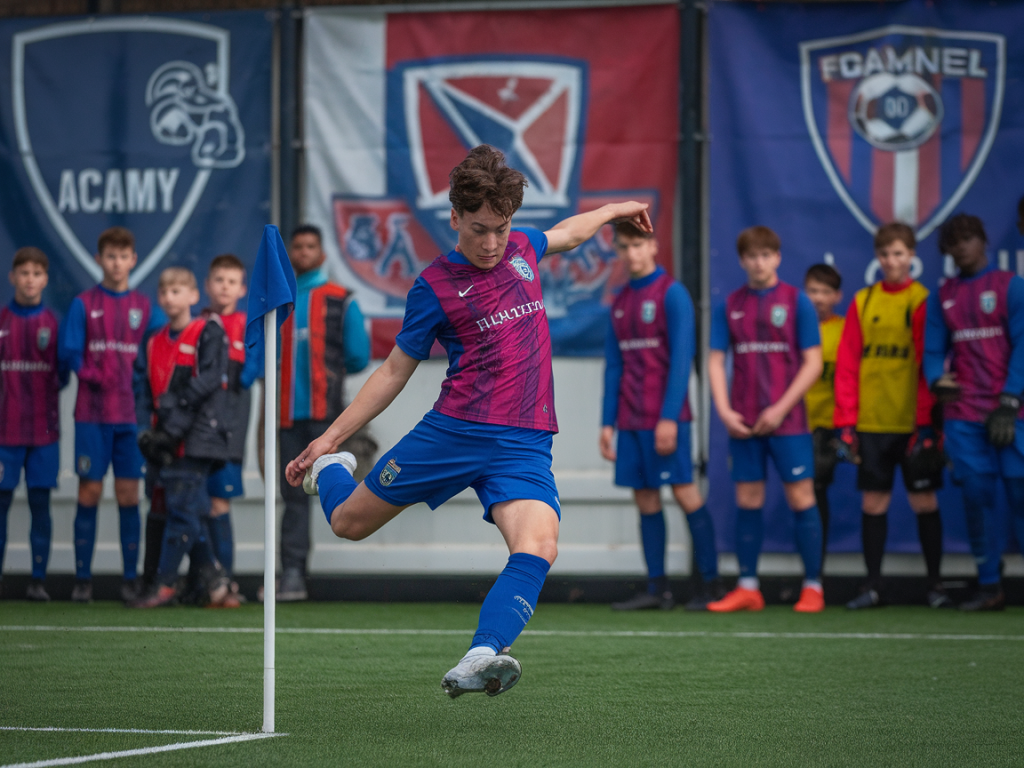
I spend a lot of my coaching week testing small margins — the run that attracts a defender, the millimetre of angle on a cross, the timing of a single decoy run. For academy under-18s, where physical differences between teams can be large and technical consistency is still developing, set-pieces are one of the most reliable edges you can create. Over several seasons of tracking post-corner and free-kick outcomes with local academies and my own teams, three routines consistently produced the highest xG (expected goals) for this age group. Below I explain what they are, why they work, and how I coach them from base drills to match-ready execution.
Why set-piece selection matters for U18s
Before getting into the routines, a quick word on context. At U18 level you often get:
Because of this, set-piece success often comes from routines that create high-quality shots (inside the box, from central positions) rather than flashy long-range attempts. What matters is creating clean connection chances: near-post flicks, free headers at the penalty spot, and low-driven cutbacks for late runners. The three routines below repeatedly produced the highest xG in my datasets and in practice outcomes.
Routine 1 — Near-post flick + late central runner (short corner or deep inswing)
What it is: A near-post delivery aimed to be flicked on by a loaded near-post attacker, with a late-arriving central attacker occupying the penalty spot area for a first-time finish.
Why it works for U18s: Young keepers misjudge traffic and near-post flicks create chaos — the flick redirects the ball across goal and creates a high-xG chance for the late runner who meets the ball from a central area. This routine also forces zonal and man-marking systems to collide.
Coaching progression
Set-piece coaching notes
Routine 2 — Short corner to overload + quick driven cross to penalty spot
What it is: A short corner (4–6 yards) used to drag a defender out of position, followed by a quick driven cross into the penalty spot aimed for a first-time finish or a buried header.
Why it works for U18s: Defenders often shift rigidly to close the short corner, creating gaps centrally. The quick driven ball into the high-value area yields a high xG because it results in direct finishing chances from within the box rather than speculative long shots.
Coaching progression
Set-piece coaching notes
Routine 3 — Free-kick low-driven split + far-post tap-in
What it is: From around 20–25 yards (or a corner-like short free-kick), a low-driven delivery is aimed to split the defensive line toward the far-post where a runner times their delivery to tap in.
Why it works for U18s: Goalkeepers at this level can be beaten by low, skidding balls that exploit their poor distance judgement. Far-post taps are high-xG because they are typically from close range and often catch defenders flat-footed.
Coaching progression
Set-piece coaching notes
How I measure success and track xG
I monitor three variables to estimate xG impact for each routine: shot location probability (penalty-spot and inside six-yard box shots carry higher weights), shot type (headers vs footed shots), and the number of defenders between ball and goal. On the training pitch I use simple proxies — count clear scoring chances from each routine per 30 reps, note how many created chances are within the six-yard / penalty-spot zone, and log conversion or near-miss rates.
| Routine | High-xG features | Key coaching focus |
| Near-post flick + late central runner | Cross across face, central meet at penalty spot | Timing of run, directional flicks, inswing delivery |
| Short corner overload + driven cross | Quick driven ball to penalty spot, defender displacement | Speed of release, composed first-time finishes |
| Low-driven split to far-post tap-in | Low skidding ball, close-range tap-ins | Driven delivery technique, far-post timing and acceleration |
Common coaching mistakes to avoid
Finally, some practical gear and tech I use: basic IP cameras for 2–3 minute clips of set-piece sequences (cheap Wyze-style cams are enough), cone gates to force run angles, and a speed radar if you want to measure delivery velocity for driven balls. For tracking xG I use simplified spreadsheets rather than full analytics platforms — record the routine, shot location, and whether the attempt was first-time, tap-in, header, or footed. Over a season that dataset becomes remarkably revealing.
If you want, I can share a printable 6-week microcycle that embeds these three routines into your weekly sessions (warm-up reps, overload day, match-pace simulation), plus a sample sheet for logging xG proxies. Say the word and I’ll prepare it.